
An ankle sprain can make everyday activities such as walking, climbing stairs, standing, and exercising difficult. It occurs when the ankle twists or rolls beyond its normal range, stretching or damaging the ligaments that support the joint. Common symptoms include pain, swelling, bruising, and difficulty putting weight on the affected foot.
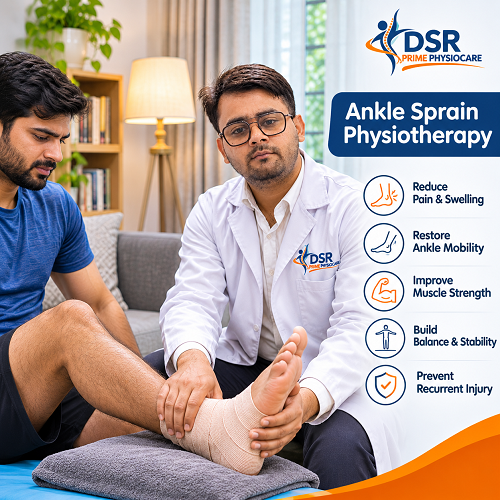
Ankle Sprain Physiotherapy plays an important role in restoring ankle movement, improving muscle strength, and rebuilding joint stability. A structured rehabilitation programme also helps improve balance and reduce the risk of repeated injuries.
The right treatment depends on the severity of the injury, symptoms, and daily activity requirements. Physiotherapy focuses on gradual recovery so patients can return to their normal activities safely.
What Is an Ankle Sprain?
An ankle sprain is an injury to one or more ligaments that support the ankle joint. Ligaments are strong connective tissues that connect bones and help maintain joint stability.
Most ankle sprains affect the outer ligaments. They commonly occur when the foot rolls inward during walking, running, jumping, or sports activities. However, injuries can also affect the inner ankle ligaments or the ligaments connecting the lower leg bones.
Common causes include:
- Sports activities: Sudden direction changes, jumping, and awkward landings during football, basketball, or badminton.
- Uneven surfaces: Losing balance while walking on uneven roads or stepping into potholes.
- Incorrect landing: Landing awkwardly after a jump or stepping on another person’s foot.
- Sudden twisting: Turning the body quickly while the foot remains planted.
- Previous injuries: An ankle that has not regained its strength and stability may be more vulnerable to another sprain.
What Are the Common Symptoms of an Ankle Sprain?
Symptoms vary according to ligament damage. Some people experience mild discomfort, while others have considerable pain and difficulty walking.
Common symptoms include:
- Pain: Discomfort around the injured ligament, particularly while standing or walking.
- Swelling: Fluid accumulation around the injured ankle.
- Bruising: Visible skin discoloration caused by damage to small blood vessels.
- Restricted movement: Difficulty moving the foot upward, downward, inward, or outward.
- Difficulty bearing weight: Pain while standing or putting pressure on the affected foot.
- Ankle instability: A feeling that the ankle may give way during movement.
Severe pain, visible deformity, numbness, significant swelling, or inability to bear weight requires prompt medical assessment. A fracture can produce symptoms similar to an ankle sprain, and a healthcare professional may recommend an X-ray when appropriate.
What Are the Different Grades of Ankle Sprains?
Healthcare professionals generally classify ankle sprains into three grades according to the extent of ligament damage.
Grade 1: Mild Ankle Sprain
A Grade 1 sprain involves mild stretching and microscopic damage to ligament fibres. Symptoms usually include mild pain, limited swelling, and minimal difficulty walking. Significant joint instability is generally absent.
Grade 2: Moderate Ankle Sprain
A Grade 2 sprain involves a partial ligament tear. Patients may experience moderate pain, swelling, bruising, restricted movement, and difficulty bearing weight. External support and structured rehabilitation may be required.
Grade 3: Severe Ankle Sprain
A Grade 3 sprain involves a complete tear of the affected ligament. It can cause significant swelling, bruising, severe tenderness, and considerable joint instability. Medical evaluation is important before progressing with rehabilitation.
Recovery depends on the injury, associated damage, and individual healing response.
Why Is Physiotherapy Important for Ankle Sprain Recovery?
Recovering from an ankle sprain involves more than waiting for pain and swelling to disappear. The ankle must regain its movement, strength, coordination, and ability to support body weight.
Ankle Sprain Physiotherapy addresses these functional problems through an individualized rehabilitation programme.
Its main objectives include:
- Managing pain and swelling.
- Restoring ankle mobility.
- Strengthening supporting muscles.
- Improving balance and coordination.
- Restoring normal walking patterns.
- Reducing the risk of recurrent ankle injuries.
How Does Physiotherapy Help in Ankle Sprain Recovery?
Treatment progresses according to the patient’s symptoms, injury severity, and functional ability.
1. Initial Assessment and Injury Evaluation
The physiotherapist evaluates the injury mechanism, pain location, swelling, ankle movement, muscle strength, and walking ability. Balance and joint stability may also be assessed when appropriate.
This evaluation helps identify movement limitations and determine suitable rehabilitation exercises. It also helps identify patients who need further medical investigation.
2. Pain and Swelling Management
Pain and swelling can restrict movement and make walking uncomfortable. Early management may include activity modification, compression, elevation, and ice for short-term pain relief when appropriate.
External ankle support or bracing may also be recommended. Controlled movement and gradual weight-bearing are introduced according to the injury and medical assessment.
3. Restoring Ankle Mobility
Ankle stiffness can develop because of swelling, pain, and reduced movement. Physiotherapy uses gentle exercises to improve flexibility and restore normal joint movement.
Common exercises include ankle pumps, ankle circles, ankle alphabet movements, and controlled dorsiflexion and plantarflexion.
Manual therapy may also be considered when clinically appropriate to address mobility restrictions.
4. Ankle Strengthening Exercises
The muscles around the ankle support joint movement and stability. Strengthening helps improve control during walking and other daily activities.
Common exercises include resistance band movements, heel raises, toe raises, and progressive calf strengthening.
Exercise resistance and difficulty increase gradually as the patient’s symptoms improve.
5. Balance and Proprioception Training
Proprioception is the body’s ability to recognise joint position and movement. An ankle sprain can affect this ability, making the joint feel unstable.
A physiotherapist may introduce single-leg balance exercises, tandem standing and walking, wobble board training, dynamic balance exercises, and controlled landing drills.
These activities help improve coordination and ankle stability, particularly in patients with repeated sprains.
6. Gait Training and Walking Rehabilitation
Pain, swelling, and muscle weakness can change walking patterns. Gait training focuses on improving foot placement, controlled weight-bearing, and normal walking mechanics.
Rehabilitation may progress from supported walking to independent walking and stair climbing as the ankle becomes stronger.
7. Functional and Sports-Specific Rehabilitation
Patients returning to demanding activities need adequate strength, balance, and movement control.
Advanced rehabilitation may include step-up exercises, controlled hopping, landing drills, agility training, and sport-specific movements.
For athletes, rehabilitation should reflect the physical requirements of their sport. Patients can also explore our sports injury physiotherapy services in Ghaziabad for information about sports-related rehabilitation.
Best Physiotherapy Exercises for Ankle Sprain Recovery
Exercise selection depends on pain, swelling, injury severity, and current ankle function.
1. Ankle Alphabet Exercise: Sit comfortably and use your foot to trace letters in the air. This encourages ankle movement in different directions.
2. Ankle Pumps: Point your toes away from your body and then bring them towards your shin. This helps maintain gentle ankle mobility.
3. Resistance Band Exercises: Use a resistance band to perform controlled ankle movements against resistance. These exercises help strengthen supporting muscles.
4. Calf Stretching: Stand facing a wall with the injured leg behind you. Gently bend the front knee while keeping the back heel on the floor, provided stretching is appropriate for your recovery stage.
5. Heel Raises: Stand near a stable support and slowly raise and lower your heels. This strengthens the calf muscles.
6. Single-Leg Balance: Stand on the affected leg while holding a stable support nearby. This helps improve balance and ankle coordination.
These exercises should be introduced progressively under professional guidance. Avoid advanced exercises when the ankle remains severely painful or unstable.
How Long Does an Ankle Sprain Take to Heal?
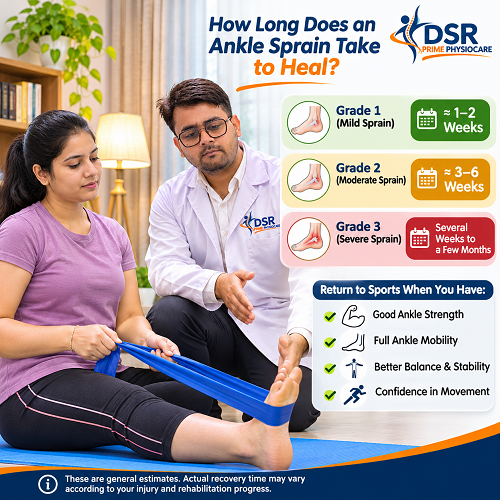
Recovery time depends on ligament damage, associated injuries, general health, and rehabilitation progress.
General recovery expectations are:
- Grade 1: Approximately 1–2 weeks.
- Grade 2: Approximately 3–6 weeks.
- Grade 3: Several weeks to a few months.
These are broad estimates, not guaranteed recovery deadlines. Severe injuries may require longer rehabilitation.
Returning to sports should depend on ankle strength, mobility, balance, confidence, and the ability to perform sport-specific movements rather than time alone.
How to Prevent Another Ankle Sprain?
Preventing another injury is an important part of rehabilitation.
- Continue ankle and calf strengthening exercises.
- Practise single-leg balance and coordination activities.
- Wear suitable footwear for daily activities and sports.
- Warm up before running, jumping, or playing sports.
- Increase exercise intensity gradually.
- Use ankle braces or taping when recommended by a healthcare professional.
Patients with repeated ankle sprains may benefit from continued balance and functional rehabilitation.
When Should You Consult a Physiotherapist?
Consider a physiotherapy assessment when ankle pain, stiffness, or weakness affects daily activities.
Professional guidance is particularly useful when:
- Swelling and discomfort continue to restrict movement.
- Walking remains difficult.
- The ankle feels weak or unstable.
- You experience repeated ankle sprains.
- Returning to exercise or sports becomes difficult.
- Ankle mobility has not returned to its previous level.
Suspected fractures and severe injuries require medical assessment before exercise-based rehabilitation.
Frequently Asked Questions About Ankle Sprain Physiotherapy
1. Can physiotherapy help heal an ankle sprain?
Yes. Physiotherapy supports recovery by improving ankle mobility, muscle strength, balance, and functional stability. Treatment depends on injury severity.
2. How many physiotherapy sessions are needed for an ankle sprain?
The number varies according to ligament damage, movement limitations, and rehabilitation progress. A physiotherapist can recommend a suitable schedule after assessment.
3. Can I walk with a sprained ankle?
Some mild sprains allow comfortable walking. However, moderate and severe injuries may make weight-bearing difficult. Do not force walking when it causes significant pain.
4. Which exercises are best for an ankle sprain?
Ankle pumps, ankle alphabet movements, resistance band exercises, heel raises, and single-leg balance exercises are commonly used during rehabilitation.
5. Can an ankle sprain cause long-term instability?
Yes. Repeated injuries or incomplete functional rehabilitation can contribute to chronic ankle instability. Strengthening and balance exercises help improve ankle control.
6. When can I return to sports after an ankle sprain?
Return to sports depends on pain, strength, mobility, balance, confidence, and sport-specific functional ability. A physiotherapist can assess readiness.
Ankle Sprain Rehabilitation at DSR Prime Physiocare
Ankle sprain recovery requires an approach that considers injury severity, individual limitations, and daily activity requirements. DSR Prime Physiocare focuses on individualized physiotherapy, therapeutic exercises, manual therapy techniques, and functional rehabilitation.
Meet Your Physiotherapist – Shadab Rana
Shadab Rana is the Founder and Lead Physiotherapist at DSR Prime Physiocare. He holds BPT and MPT (Sports Medicine) qualifications and has over four years of clinical experience in orthopedic and rehabilitation care.
His professional experience includes Synergy Health Care, Ghaziabad, Bone & Joint Orthopedic Clinic, and The Physios Clinic, Noida. He also completed his clinical internship at Yashoda Hospital, Nehru Nagar.
UPSMF Registration No.: 4210
DSR Prime Physiocare provides physiotherapy services across Noida, Ghaziabad, and Delhi NCR. Patients who need rehabilitation support at home can explore home physiotherapy services in Ghaziabad.
For an ankle injury assessment or appointment, contact +91 9354961295. Service hours are 7:00 AM to 10:00 PM.
Visit the DSR Prime Physiocare contact page to enquire about physiotherapy appointments.