
Pain can affect your ability to walk, work, exercise and perform everyday activities. Physiotherapy offers different treatment approaches to help manage pain and improve movement. Two commonly used electrotherapy techniques are Interferential Therapy (IFT) and Transcutaneous Electrical Nerve Stimulation (TENS).
Both treatments use electrical stimulation to help manage pain. However, they differ in the type of current they deliver, how the stimulation is produced and how physiotherapists apply them.
Understanding IFT vs TENS Therapy can help you learn what to expect during treatment. It can also help you discuss suitable treatment options with your physiotherapist.
Quick Answer: IFT vs TENS Therapy
IFT uses two medium-frequency alternating currents that interact to produce amplitude-modulated stimulation, commonly described in terms of a beat frequency. TENS delivers controlled electrical pulses through skin electrodes to stimulate sensory nerves.
Both therapies may help reduce pain. However, neither is suitable for every patient. The choice depends on the type of pain, medical history, clinical assessment and treatment goals.
What Is IFT (Interferential Therapy)?
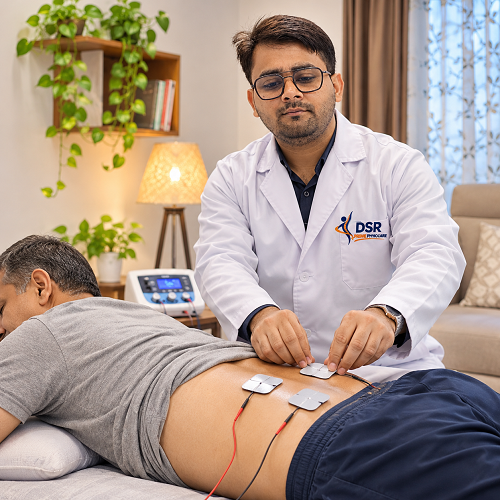
Interferential Therapy (IFT), also known as Interferential Current Therapy (IFC), is an electrotherapy technique used in physiotherapy for pain management.
It uses medium-frequency alternating electrical currents. In a commonly used four-electrode arrangement, two currents cross within the treatment area and produce an interference effect. This creates an amplitude-modulated current at a lower frequency.
The physiotherapist places adhesive electrodes on the skin around the affected area. The device then delivers controlled electrical stimulation according to the patient’s condition and comfort.
How Does IFT Therapy Work?
The amplitude-modulated electrical stimulation produced during IFT activates sensory nerve fibres. This stimulation may influence pain signal processing, although the exact pain-relief mechanisms are not fully established.
Patients usually experience a mild tingling or vibrating sensation during treatment. The intensity should remain comfortable and should not cause pain or burning.
Physiotherapists may consider IFT as part of a treatment plan for conditions such as:
- Lower back pain and muscular discomfort.
- Neck pain and muscle tension.
- Knee pain and certain joint-related conditions.
- Musculoskeletal pain following an injury.
- Selected cases of chronic pain.
Potential Benefits of IFT Therapy
IFT may provide temporary pain relief and help some patients feel more comfortable during movement. It can also be used alongside therapeutic exercises and other rehabilitation techniques.
However, results vary between individuals. IFT does not repair damaged tissues or cure the underlying cause of every painful condition. A proper assessment is important before starting treatment.
Patients interested in this treatment can learn more about IFT Physiotherapy and its role in pain management.
What Is TENS (Transcutaneous Electrical Nerve Stimulation)?
Transcutaneous Electrical Nerve Stimulation (TENS) is a non-invasive electrotherapy technique that uses mild electrical pulses to stimulate nerves through the skin.
A TENS machine connects to small adhesive electrode pads. The physiotherapist places these pads near the painful area and adjusts the stimulation settings according to the patient’s needs.
Unlike IFT, TENS generally delivers pulsed electrical stimulation directly through the electrodes without using two intersecting medium-frequency currents.
How Does TENS Therapy Work?
TENS mainly works by stimulating sensory nerves. This stimulation may help reduce the transmission or perception of pain signals within the nervous system.
The pain-modulating effects of TENS may also involve endogenous opioid pathways, particularly with certain low-frequency stimulation settings. However, the mechanisms can vary with the stimulation parameters.
During treatment, patients generally feel a gentle tingling, tapping or buzzing sensation. The intensity should be comfortable and should not cause discomfort.
Common Uses of TENS Therapy
Physiotherapists may consider TENS for different types of pain, including:
- Lower back and neck pain.
- Knee and joint-related discomfort.
- Certain sports injuries.
- Muscular pain.
- Some forms of acute and chronic pain.
Potential Benefits of TENS Therapy
TENS may provide temporary pain relief and help patients manage discomfort during daily activities. Portable TENS devices are also available for selected patients who have received appropriate professional guidance.
However, TENS does not work equally well for everyone. It should not replace an assessment or a complete rehabilitation programme when the underlying condition requires further treatment.
IFT vs TENS Therapy: What Are the Key Differences?
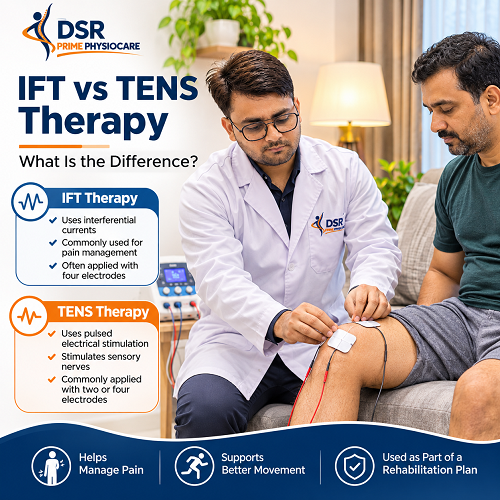
The main difference between IFT and TENS lies in their electrical stimulation methods.
IFT uses interacting medium-frequency currents to produce amplitude-modulated stimulation, whereas TENS delivers pulsed electrical stimulation through skin electrodes.
These differences affect the treatment setup and the parameters selected by the physiotherapist.
| Comparison Factor | IFT Therapy | TENS Therapy |
| Full Form | Interferential Therapy | Transcutaneous Electrical Nerve Stimulation |
| Current Type | Medium-frequency alternating currents | Pulsed electrical current |
| Working Principle | Uses interacting currents to produce an amplitude-modulated effect | Stimulates sensory nerves through electrical pulses |
| Electrode Placement | Commonly uses four electrodes in a quadripolar arrangement | Commonly uses two or four electrodes |
| Main Purpose | Pain management | Pain management |
| Treatment Sensation | Gentle tingling or vibration | Gentle tingling or tapping |
| Equipment | Interferential therapy machine | TENS machine |
| Treatment Setting | Commonly administered in supervised physiotherapy settings | Available for clinic-based treatment and selected home use |
| Treatment Selection | Based on clinical assessment | Based on clinical assessment |
Which Is Better: IFT or TENS Therapy?
There is no single answer for every patient. Both treatments may help manage certain types of pain, but their effectiveness depends on individual circumstances.
A 2018 systematic review of eight studies involving 825 participants found no statistically significant difference between IFT and TENS for pain relief. However, a 2023 review of chronic non-specific low back pain found low-quality evidence that IFT may provide slightly greater immediate pain relief than TENS, without a demonstrated advantage in reducing disability.
2018 Systematic Review: TENS and Interferential Current
2023 Systematic Review: IFT for Chronic Non-Specific Low Back Pain
The belief that IFT reaches deeper tissues does not establish that it provides better clinical pain relief. Similarly, the portability of TENS does not mean it is more effective for every pain condition.
For example, a patient who needs temporary pain relief to participate in prescribed exercises may be considered for either modality, depending on sensory response, treatment tolerance and clinical suitability
IFT vs TENS Therapy for Different Types of Pain
The evidence for IFT and TENS is not equally established across all pain conditions. The following comparisons explain what may be considered for back, neck, knee and sports-related pain, while recognising that neither modality replaces condition-specific rehabilitation.
IFT vs TENS for Back Pain
Lower back pain can develop due to muscle strain, prolonged sitting, movement-related problems and other musculoskeletal conditions.
For chronic non-specific low back pain, research suggests that IFT may provide slightly greater immediate pain relief than TENS, although the evidence is of low quality and does not establish a clear advantage in reducing disability. Therefore, the choice should also consider the patient’s functional limitations and rehabilitation goals.
Treatment may also include core strengthening, mobility exercises and posture-related guidance.
IFT vs TENS for Neck Pain
Neck pain may occur due to muscle tension, prolonged screen use, poor movement habits or cervical conditions.
The choice between IFT and TENS should depend on the assessment of neck movement, muscle-related symptoms, sensory changes and functional limitations. Neither modality should replace appropriate exercises and management of the underlying cause.
A rehabilitation programme may include gentle neck exercises, mobility training and postural advice.
IFT vs TENS for Knee Pain
Knee discomfort can result from osteoarthritis, sports injuries, muscle weakness or post-operative conditions.
For knee osteoarthritis, post-operative pain or sports-related knee injuries, the assessment should consider joint swelling, range of motion, quadriceps strength and weight-bearing ability. These findings help determine whether electrical stimulation has a useful supporting role alongside rehabilitation.
For many knee conditions, strengthening the surrounding muscles and improving joint function are important parts of rehabilitation.
IFT vs TENS for Sports Injuries
Sports injuries may involve ligament sprains, muscle strains and other soft-tissue problems.
After a ligament sprain or muscle strain, pain management is only one part of recovery. Rehabilitation must also address progressive loading, strength, balance and sport-specific movement before the patient returns to training or competition.
The rehabilitation programme should match the injury and the patient’s stage of recovery.
IFT vs TENS for Chronic Pain
Chronic pain can affect daily activities, sleep and overall physical function. TENS and IFT may provide temporary relief for some individuals, although responses vary.
A comprehensive approach may combine appropriate pain-management techniques with graded exercise, functional rehabilitation and patient education.
Can IFT and TENS Therapy Be Used Together?
Yes, a physiotherapist may consider both IFT and TENS during different stages of treatment when there is a clinical reason to do so.
However, using both treatments together does not automatically provide better results. They have overlapping pain-management purposes, and combining them may not offer additional benefits for every patient.
The physiotherapist considers the patient’s response, treatment goals and overall rehabilitation plan before selecting the modalities.
The main objective is not to use more machines. It is to choose appropriate treatments that support comfortable movement and functional recovery.
What Happens During an IFT or TENS Therapy Session?
An IFT or TENS session usually begins with a physiotherapy assessment. The physiotherapist asks about your symptoms, medical history, pain location and movement difficulties.
Based on the findings, the physiotherapist decides whether electrical stimulation is appropriate.
How Is the Treatment Performed?
- Skin preparation: The treatment area is checked and cleaned before electrode placement.
- Electrode placement: Adhesive electrodes are positioned around or near the affected area according to the selected technique.
- Intensity adjustment: The machine settings are adjusted gradually to provide comfortable stimulation.
- Treatment monitoring: The physiotherapist monitors your response and makes adjustments when necessary.
- Post-treatment guidance: You may receive advice about exercises, movement and further rehabilitation.
The treatment duration and settings depend on the patient’s condition and clinical requirements. Patients should not increase the electrical intensity beyond professionally recommended levels.
IFT vs TENS Therapy: Safety, Risks and Precautions
IFT and TENS are generally well tolerated when used appropriately. However, electrical stimulation is not suitable for everyone.
Certain precautions are important before starting treatment:
- Pacemakers and implanted devices: Electrical stimulation may interfere with pacemakers and other implanted electronic devices, depending on the device and electrode location. Patients with implanted devices should consult their treating specialist before starting IFT or TENS.
- Pregnancy: IFT and TENS use during pregnancy requires individual clinical assessment. Treatment should not be applied over the abdomen, pelvis or lower back without guidance from an appropriate healthcare professional.
- Skin problems: Electrodes should not be placed over broken, irritated or infected skin.
- Reduced sensation: Patients with impaired skin sensation may not recognise excessive stimulation or irritation.
- Medical conditions: People with neurological conditions, circulation problems or other relevant medical concerns should receive an individual assessment.
Stop treatment and inform your physiotherapist if you experience burning, unusual pain, dizziness or significant skin irritation.
Never use an electrotherapy device without understanding its safety instructions and suitability for your condition.
How Does a Physiotherapist Choose Between IFT and TENS?
The choice between IFT and TENS should consider the type of pain, the patient’s sensory response, treatment tolerance and the purpose of electrical stimulation within the rehabilitation plan.
A physiotherapist considers several factors:
- Pain characteristics: Whether symptoms are acute, persistent or linked to a diagnosed musculoskeletal condition.
- Sensory response: Whether the patient can feel the stimulation normally and report changes in intensity.
- Electrode positioning: Whether electrodes can be placed safely around the treatment area.
- Treatment tolerance: Whether the selected stimulation produces comfortable sensory input without irritation or excessive discomfort.
- Functional objective: Whether temporary pain relief could help the patient participate in prescribed movement or exercise.
- Previous response: Whether an earlier session produced meaningful improvement in pain or activity.
At DSR Prime Physiocare, Shadab Rana, BPT, MPT (Sports Medicine), leads patient-focused physiotherapy care. His clinical experience includes orthopedic and rehabilitation care across Noida and Ghaziabad.
His treatment approach combines clinical assessment with manual therapy, therapeutic exercises and functional rehabilitation. IFT or TENS may be considered as a supporting option when appropriate, rather than as a replacement for condition-specific rehabilitation.
Frequently Asked Questions About IFT vs TENS Therapy
Is IFT therapy more effective than TENS?
Overall research does not establish IFT as consistently more effective than TENS. Although some evidence suggests a possible short-term advantage for IFT in chronic non-specific low back pain, the quality of this evidence is low.
Can TENS therapy help with back pain?
TENS may provide temporary pain relief for some people with back pain, but its effectiveness varies. For chronic non-specific low back pain, research has not established a consistent advantage of TENS over IFT. Exercise and appropriate rehabilitation remain important parts of care.
Is IFT therapy painful?
IFT should generally produce a comfortable tingling or vibrating sensation. It should not cause burning or painful stimulation.
How long does an IFT or TENS session take?
Session duration varies according to the patient’s condition, treatment settings and physiotherapist’s plan. There is no single duration suitable for everyone.
Can I use a TENS machine at home?
Some patients can use portable TENS devices at home after receiving appropriate guidance. Follow the manufacturer’s instructions and professional safety advice.
Are IFT and TENS therapy safe?
Both are generally well tolerated when used correctly. However, certain medical conditions, implanted devices and skin problems require special precautions.
Get Professional Physiotherapy Guidance at DSR Prime Physiocare
If you are considering IFT or TENS for back pain, neck pain, knee pain or another musculoskeletal problem, the first step is to identify the cause of your symptoms and assess your movement limitations. At DSR Prime Physiocare, the physiotherapy assessment helps determine whether electrotherapy has a useful role alongside exercises and other rehabilitation methods.
At DSR Prime Physiocare, Shadab Rana provides patient-focused physiotherapy care for people experiencing back pain, neck pain, knee problems, sports injuries and mobility difficulties.
https://share.google/jQGzPUnZmrXsUcbCL
Services are available across Noida, Ghaziabad and Delhi NCR, including home physiotherapy in Ghaziabad.
To discuss your physiotherapy requirements or arrange an assessment, call +91 9354961295 or visit the DSR Prime Physiocare contact page.