
Pain can make walking, exercising and performing everyday activities difficult. Therefore, physiotherapy may form an important part of managing movement problems and improving physical function.
One treatment used in some physiotherapy clinics is IFT physiotherapy, also known as interferential therapy. It uses electrical currents delivered through electrodes placed on the skin. A physiotherapist may consider this treatment for selected pain-related conditions as part of an individual rehabilitation plan.
However, IFT is not suitable for every patient or every type of pain. Its effectiveness also depends on the condition being treated and the available clinical evidence.
This guide explains the IFT full form in physiotherapy, how interferential currents work, how electrode placement is selected, and what clinical research says about its uses, benefits and safety. You will also understand how IFT compares with TENS and why a complete physiotherapy plan may involve more than electrotherapy.
What Is the IFT Full Form in Physiotherapy?
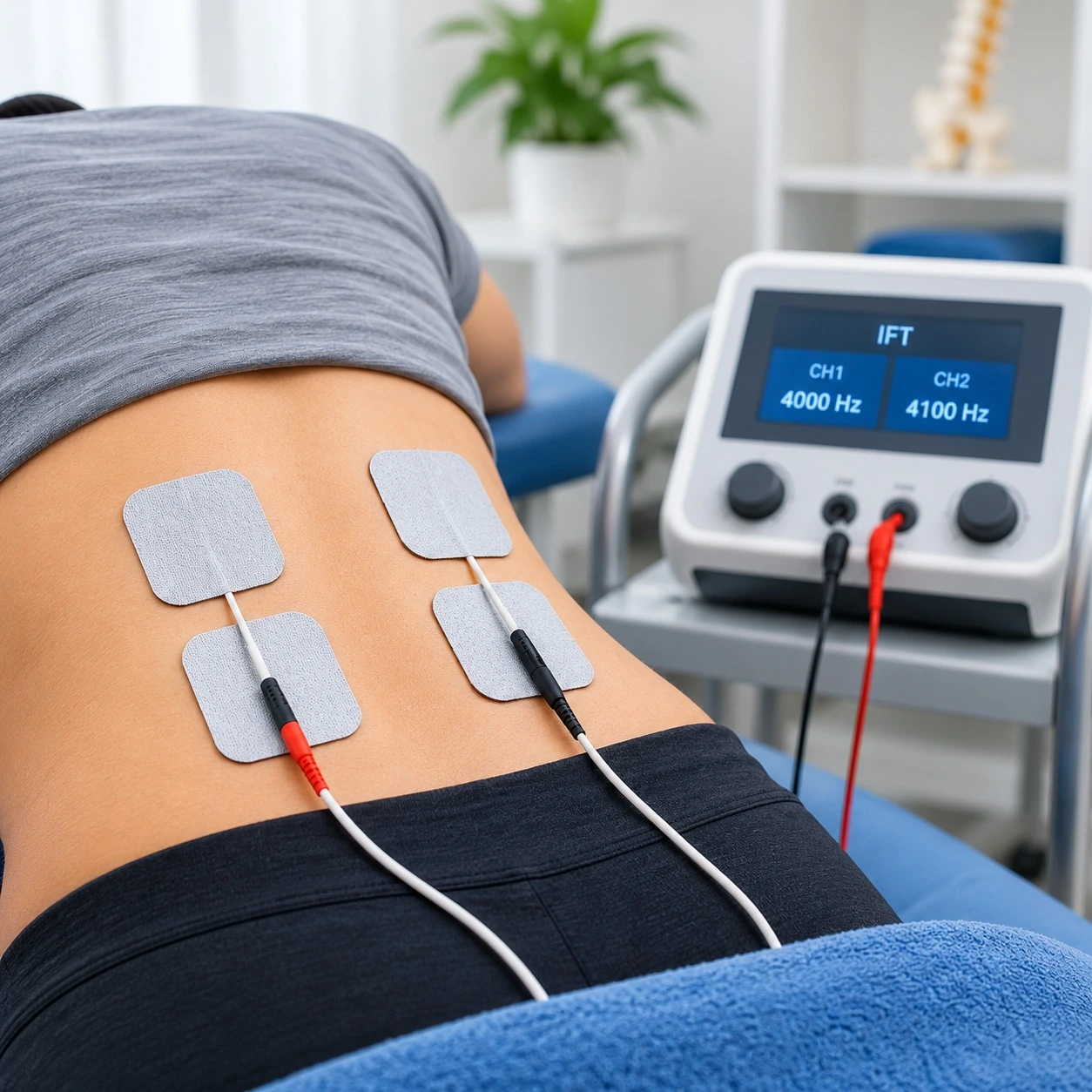
IFT stands for Interferential Therapy, an electrotherapy technique that uses intersecting medium-frequency electrical currents to produce an amplitude-modulated stimulation effect.
In medical and physiotherapy contexts, IFT generally refers to interferential therapy or interferential current therapy. The treatment is non-invasive, meaning it does not require surgery or an injection.
During an IFT treatment session, the physiotherapist places electrodes around the selected treatment area. The machine then delivers electrical currents according to the prescribed settings. As a result, the patient may experience a mild tingling or buzzing sensation.
IFT may be considered for selected musculoskeletal complaints. Nevertheless, its suitability depends on the patient’s condition, medical history, treatment goals and response to therapy.
It is also important to understand that IFT primarily aims to manage symptoms in appropriate cases. It should not automatically be considered a cure for an underlying joint, muscle or spinal problem.
How Does Interferential Therapy Work?

Interferential therapy uses electrical currents delivered through skin electrodes. Its intended effects depend on the stimulation settings, electrode placement and treatment objective.
The physiotherapist first identifies the area to be treated. Next, the electrodes are positioned according to the clinical assessment, and the machine settings are adjusted to provide a tolerable sensation.
During treatment, the patient may notice tingling beneath the electrodes. However, the sensation should not be painful or cause a burning feeling. Any significant discomfort should be reported immediately.
What Is Beat Frequency in IFT?
Beat frequency is a technical term associated with interferential current stimulation. It describes the difference between the frequencies of two interacting currents in the conventional interferential setup.
The selected frequency and other machine settings depend on the treatment objective and equipment. Therefore, there is no single setting that should be used for every patient.
Although IFT is sometimes described as reaching deeper tissues, this does not automatically mean it provides better pain relief than other electrotherapy methods. Its clinical value must be assessed using evidence relevant to the condition being treated.
What Are the Potential Benefits of IFT Physiotherapy?
IFT physiotherapy, also known as interferential current therapy, is used to help manage certain musculoskeletal pain symptoms. However, its effectiveness depends on the condition being treated, the available clinical evidence and the patient’s response.
Possible Support for Movement and Rehabilitation
Pain can make everyday movements and therapeutic exercises uncomfortable. When IFT provides short-term pain relief, it may make activities such as walking, joint movement or prescribed therapeutic exercises more comfortable for some patients. However, IFT should support an appropriate rehabilitation plan rather than replace exercises or treatment directed at the underlying problem.
For this reason, a physiotherapist should assess whether IFT is helping the patient meet specific rehabilitation goals.
Non-Invasive Treatment
IFT delivers electrical stimulation through electrodes placed on the skin. It does not require an incision or injection.
However, non-invasive treatment is not automatically suitable for everyone. A physiotherapist should screen for relevant medical conditions, implanted electronic devices, altered sensation and other safety concerns before selecting the treatment.
This describes how the treatment is delivered; it does not, by itself, prove that IFT is more effective than other treatment options.
Individualised Treatment
IFT should be selected according to the patient’s assessment, symptoms, treatment goals and response to previous sessions. The physiotherapist should review changes in pain intensity, movement and daily activities to determine whether IFT is producing a measurable benefit or whether the treatment plan needs adjustment.
If improvement is limited, the clinician may reconsider its role and focus on other suitable interventions, including therapeutic exercises and functional rehabilitation.
Important: These are potential benefits, not guaranteed outcomes. Current research suggests that IFT may help with certain pain conditions, particularly in the short term, but its effectiveness varies. It should not be presented as a replacement for an appropriate assessment or a complete rehabilitation plan.
What Are the Uses of IFT in Physiotherapy?
IFT may be considered as part of a physiotherapy plan for selected musculoskeletal conditions. However, the presence of pain alone does not establish that interferential therapy is appropriate.
IFT for back pain
Back pain can have several causes, including muscle-related problems and spinal conditions. A physiotherapist should assess the symptoms and identify whether further medical evaluation is necessary.
Research has examined IFT for chronic non-specific low back pain, with some evidence of short-term pain relief. However, this finding should not be assumed to apply to every cause of back pain.
IFT for knee pain
Knee pain may be associated with osteoarthritis, injuries or other joint problems. The appropriate treatment depends on the underlying cause and the patient’s functional limitations.
IFT may help manage pain symptoms in selected cases, but it does not repair damaged cartilage or reverse structural changes in the knee. Where appropriate, rehabilitation may also involve strengthening, mobility work and functional exercises.
IFT for neck pain
Neck pain may develop for different reasons, including muscle strain and other musculoskeletal conditions. A physiotherapist can assess movement, symptoms and relevant warning signs before recommending treatment.
Depending on the assessment, the treatment plan may include exercise, movement guidance and other suitable interventions.
IFT for shoulder pain
Shoulder pain can involve the muscles, tendons, joint or surrounding structures. Consequently, treatment should reflect the cause of the symptoms rather than relying on electrotherapy alone.
A physiotherapist can determine whether IFT has a suitable role alongside exercises and functional rehabilitation.
IFT for sports-related injuries
Sports-related pain may require a structured assessment, particularly after a sudden injury. IFT, when appropriate, may be considered for symptom management, but it does not replace injury-specific rehabilitation, progressive loading or return-to-sport assessment.
For related information, read our guide to sports injury physiotherapy in Ghaziabad.
These examples describe possible clinical considerations rather than proof that IFT is effective for every listed condition. Its suitability and supporting evidence must be evaluated individually.
How Is IFT Treatment Performed?
The IFT treatment process varies according to the patient’s needs, the equipment and the clinician’s assessment. A typical session may involve the following steps.
Step 1: Patient assessment
First, the physiotherapist reviews the symptoms, medical history and functional difficulties. They may also assess movement and the affected area.
This step helps determine whether IFT is appropriate and whether another form of assessment or treatment is necessary.
Step 2: IFT electrode placement
In conventional four-electrode IFT, the electrodes are positioned in two pairs so that the currents intersect around the selected treatment area. The exact arrangement depends on the machine configuration, treatment objective and clinical assessment.
There is no universal electrode placement pattern for every condition. For example, electrode placement for neck symptoms may differ from the setup used for knee or back complaints.
Patients should not copy an electrode placement diagram from the internet without professional guidance.
Step 3: Machine settings and stimulation
The physiotherapist adjusts the current intensity and other device parameters according to the treatment objective, the patient’s tolerance and the equipment instructions.
The patient may feel a mild tingling sensation. However, burning, sharp pain or significant discomfort should be reported immediately.
Step 4: Monitoring and review
During the session, the physiotherapist monitors the patient’s response. They may adjust or stop the treatment if the patient experiences discomfort.
Afterward, the clinician can assess whether the treatment has helped and decide how it fits into the wider rehabilitation plan.
IFT Frequency, Parameters and Session Duration
IFT machines allow the physiotherapist to adjust several treatment parameters. These may include the electrical frequencies, stimulation intensity, treatment duration and electrode arrangement.
However, the appropriate settings depend on the clinical objective, the patient’s condition, the equipment and the individual’s response.
The following principles are important:
- Frequency: IFT machines use carrier frequencies and, in conventional interferential therapy, an amplitude-modulated (beat) frequency. The physiotherapist selects the relevant settings according to the equipment and treatment objective.
- Intensity: Stimulation should be adjusted by the treating professional to an appropriate and tolerable level.
- Electrode placement: The arrangement should suit the treatment area and clinical objective.
- Treatment duration: Session length should follow the clinician’s plan rather than a universal online recommendation.
Therefore, patients should not use fixed machine settings or self-treatment instructions taken from an article, video or presentation.
The physiotherapist should also review whether continued IFT treatment is providing meaningful benefit. If progress is limited, the overall treatment plan may need to change.
Does IFT Physiotherapy Actually Work?
IFT physiotherapy may help reduce pain in some patients. However, its effectiveness depends on the condition being treated, the outcome measured and the quality of the available research.
A 2023 systematic review and meta-analysis examined 13 randomised controlled trials involving 1,367 participants with chronic, non-specific low back pain. The researchers found moderate-quality evidence that interferential current reduced pain and disability immediately after treatment compared with a placebo. However, the same benefits were not established at intermediate-term follow-up.
Medical evidence: Effectiveness of interferential current in chronic non-specific low back pain — 2023 systematic review.
In addition, a 2022 systematic review of musculoskeletal pain included 35 trials, with 19 contributing to the meta-analysis. It found that IFT alone provided better pain relief than placebo at treatment discharge. However, IFT was not consistently more effective than other treatments or standard care when used alongside them. The authors also highlighted limitations in the available evidence.
Medical evidence: A systematic review and meta-analysis investigating the pain-relieving effect of interferential current.
What Should You Consider When Evaluating IFT?
Research findings need to be interpreted carefully. Consider these important questions:
- Pain relief: Did patients experience a meaningful reduction in pain?
- Daily function: Did the treatment improve movement or the ability to perform everyday activities?
- Duration of benefit: Did the improvement continue after treatment ended?
- Comparison with other treatments: Did IFT provide additional benefits over placebo, exercise or standard care?
- Research quality: Were the studies sufficiently reliable, and were their findings consistent?
These factors help distinguish a possible short-term benefit from evidence of lasting improvement.
Furthermore, findings for one condition should not automatically be applied to another. Evidence for chronic low back pain, for example, does not establish the same effectiveness for shoulder pain, neck pain or every type of knee pain.
Overall, IFT may be useful for selected patients, particularly for short-term symptom relief. However, the available research does not establish that it is consistently superior to other treatments or that it provides lasting recovery for every condition. A physiotherapist should assess whether it is appropriate as part of an individualised rehabilitation plan.
IFT vs TENS: What Is the Difference?

IFT and TENS are two different forms of electrotherapy used for pain management. Their main difference lies in how electrical stimulation is generated and delivered through skin electrodes.
| Feature | IFT | TENS |
| Full form | Interferential Therapy | Transcutaneous Electrical Nerve Stimulation |
| Electrical stimulation | Uses interferential current stimulation | Uses electrical pulses delivered through skin electrodes |
| Common purpose | Used with the aim of managing selected pain symptoms | Commonly used for pain relief |
| Treatment setup | Electrodes and machine settings selected for the treatment goal | Electrodes and stimulation settings selected for the treatment goal |
| Suitable use | Depends on the condition and clinical assessment | Depends on the condition and clinical assessment |
The main difference is the electrical stimulation method. However, this difference alone does not establish that one treatment is more effective than the other.
For a more detailed comparison of these two electrotherapy methods, read our guide on IFT vs TENS Therapy, including their differences, uses, benefits and safety considerations.
A physiotherapist should select between IFT and TENS based on the patient’s condition, treatment goals, safety considerations and the available clinical evidence.
IFT Side Effects and Contraindications
IFT is non-invasive, but unwanted effects can occur. Therefore, patients should undergo appropriate screening before treatment.
Possible side effects of IFT
Potential problems may include:
- Skin irritation around the electrode area.
- Uncomfortable tingling or excessive stimulation.
- Discomfort associated with unsuitable electrode placement or machine settings.
If you experience burning, significant pain or an unusual reaction, tell the physiotherapist and stop the treatment until the problem has been assessed.
IFT contraindications and precautions
Not every patient is suitable for electrotherapy. The physiotherapist should review the medical history, treatment area, device instructions and relevant clinical precautions.
Tell your physiotherapist if you have:
- An implanted electronic device, such as a pacemaker, or another implant that may affect the safety of electrical stimulation.
- Reduced or altered sensation in the treatment area.
- Broken, irritated or damaged skin.
- Pregnancy, particularly if treatment is being considered near the abdomen, lower back or pelvic region, or any medical condition that may affect treatment suitability.
- Any other condition for which you have been advised to take precautions with electrical stimulation.
These examples are not a complete contraindication list. Specific restrictions depend on the device, treatment site and individual medical circumstances. Do not assume that IFT is safe simply because it is non-invasive.
When should you seek medical assessment?
Severe, unexplained or worsening pain should not be managed with electrotherapy alone. For example, new or progressive limb weakness, loss of bladder or bowel control associated with back pain, or significant symptoms following a serious injury may require urgent medical assessment.
The appropriate response depends on the symptoms and their severity.
How Many IFT Sessions Are Needed?
There is no fixed number of IFT sessions that applies to every patient. The treatment plan depends on the condition, the response to therapy and the patient’s functional goals.
A physiotherapist should review progress rather than continuing treatment automatically.
During follow-up, they may consider whether pain has changed, movement has improved and everyday activities have become easier. In addition, they should assess whether IFT is contributing to meaningful progress.
If the treatment does not provide a useful benefit, the clinician may reconsider its role and discuss other suitable options.
Be cautious of promises that IFT will permanently resolve pain within a guaranteed number of sessions.
Can IFT Replace Other Physiotherapy Treatments?
IFT should not automatically replace exercise-based rehabilitation or other appropriate care. For many musculoskeletal problems, treatment also involves improving movement, strength and the ability to perform daily activities.
Depending on the assessment, a physiotherapy plan may include:
- Therapeutic exercises tailored to the patient’s needs.
- Mobility and strengthening exercises where appropriate.
- Functional movement and balance training.
- Advice on activity modification and a gradual return to normal activities.
- Progress reviews and adjustments to the rehabilitation plan.
The aim is to address the patient’s functional limitations rather than focusing only on temporary symptom relief.
You can learn more about physiotherapy rehabilitation and the conditions we treat.
For older adults, the treatment approach should reflect individual mobility, health and functional needs. See our page about physiotherapy for senior citizens in Noida.
Similarly, patients who need treatment at home can explore home physiotherapy in Ghaziabad. Service suitability depends on the patient’s needs and the care available.
Frequently Asked Questions About IFT Physiotherapy
What is the IFT full form in medical terminology?
In a physiotherapy context, IFT generally stands for Interferential Therapy. The meaning of an abbreviation can vary across medical contexts, so the surrounding subject should always be considered.
What is IFT treatment in physiotherapy?
IFT treatment uses electrical currents delivered through skin electrodes. A physiotherapist may consider it for selected pain-related complaints after assessing the patient.
What are the main uses of IFT?
IFT is used in some physiotherapy settings with the aim of managing certain pain symptoms. Its suitability and effectiveness depend on the condition and the available evidence.
What are the side effects of IFT physiotherapy?
Possible unwanted effects include skin irritation and uncomfortable stimulation. Correct screening, electrode placement and machine settings help reduce avoidable problems.
What are the contraindications of IFT?
Contraindications and precautions depend on the patient’s medical history, the treatment area and the equipment. Implanted electronic devices, altered sensation, skin problems and pregnancy may require additional assessment.
What is the difference between IFT and TENS?
IFT uses interferential current stimulation, whereas TENS uses electrical pulses delivered through skin electrodes. Neither method is universally better for every condition.
Can IFT be used for back or knee pain?
A physiotherapist may consider IFT in selected cases. However, back and knee pain have different possible causes, so an assessment is necessary before deciding on treatment.
Is IFT a permanent solution for pain?
IFT should not be described as a guaranteed permanent solution. Symptom relief varies, and appropriate management depends on the underlying condition and the patient’s rehabilitation needs.
About the Author
Shadab Rana — Founder & Physiotherapist
Shadab Rana is a physiotherapist with BPT and MPT (Sports Medicine) qualifications and over four years of clinical experience.
His listed areas of expertise include individualised assessment, manual therapy, therapeutic exercise and functional rehabilitation.
His professional experience includes Synergy Health Care in Ghaziabad, Bone & Joint Orthopedic Clinic, and The Physios Clinic in Noida.
He also completed a clinical internship at Yashoda Hospital, Nehru Nagar. His supplied registration number is UPSMF Reg. No. 4210.